Draw against commission works when recovery rules are clear
November 25, 2026
Pralok Chhajed
Pralok Chhajed
Key Insights
India's Code on Wages, in force since 21 November 2025, caps total deductions from wages at 50% in any wage period (Code on Wages, 2019, Section 18(3)).
In this blog:
What a draw against commission is, in plain terms
Why pharma, consumer goods and financial services teams use draws
What a draw costs when recovery rules are vague
How to set up a draw that reps trust
Many teams I speak with already run a draw. They just don't call it that. A new rep gets a guaranteed incentive for three months. An agent gets an advance against first-year commission. The money goes out easily. The trouble starts later, when nobody can find the rule for what happens if the rep falls short, how the gap comes back, or what happens when they resign. Recovery becomes a negotiation, one rep at a time. I now think the draw itself is rarely the problem. Vague recovery rules are. Once the rules are clear and visible, a draw does what it should: it keeps good people while they ramp.
Ask your HR head this week: what happens to a rep's unrecovered draw when they resign?
Table Of Content
What a draw against commission is, in plain terms
A draw against commission is an advance on commission a person hasn't earned yet. The company pays a set amount each period. When real commission comes in, the draw is set off against it.
If earned commission is higher than the draw, the person gets the difference. If it's lower, what happens next depends on the type of draw.
Recoverable draw. The shortfall is carried forward and recovered from future commission.
Non-recoverable draw. The shortfall is written off. The person keeps the draw either way.
Guaranteed minimum for new joiners. A non-recoverable draw for a fixed ramp period, often the first few months.
In India, the third type is common, usually under another name. Pharma calls it a new-joiner guarantee. Insurance calls it an advance or a stipend. The mechanics are the same.
A draw differs from a salary. Salary is fixed and owed. A draw is paid against expected commission, so the rules for setting it off matter. Our guide to the non-recoverable draw covers that type in depth.
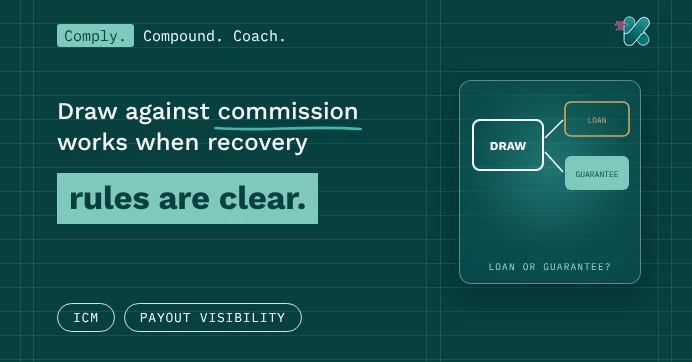
A draw is either a loan or a guarantee, and the plan must say which.
Why pharma, consumer goods and financial services teams use draws
Every industry uses draws for the same reason: income takes time to catch up with effort. Who gets the draw, and why, changes by industry.
Industry
Who usually gets a draw
Why
Where it goes wrong
Pharma
New medical reps, and reps moved to a vacant HQ
Doctor relationships take months to build
Guarantee periods tracked in Excel, missed on transfer
FMCG and consumer goods
New sales officers, and teams in off-season or launch areas
Seasonal products and new outlets sell slowly at first
Draws given regionally with no common rule
Banking and lending
New relationship managers and new branches
Loan files take weeks to disburse
Draw not set off when disbursals land late
Insurance
New agents and advisors
First-year commission arrives after policies issue
Recovery after free-look cancellations done by hand
Consumer durables and real estate
Channel partners and counter staff
Long buying cycles and big-ticket sales
Advances to partners not reconciled with final commission
The pattern repeats in each row. The draw is easy to pay. The setoff and recovery are where teams struggle.
Draws protect people during ramp. The risk sits in the setoff.
What a draw costs when recovery rules are vague
A vague draw costs more than the money advanced. It costs trust.
Start with the balance. A rep falls short for two months, and the gap carries forward. By month four, they owe more than they can earn back. Many simply resign, and the company loses the person and the balance.
Then the disputes. Was the draw a guarantee or a loan? Does a transfer reset it? Does a late disbursal count toward this month or next? When the plan doesn't say, managers decide case by case, and two reps in the same spot get different answers.
Recovery from salary has legal limits too. Under the Code on Wages, total deductions from wages in any wage period can't exceed 50%. For central-sphere employers, the Wages (Central) Rules, 2026 carry any excess forward to later wage periods, recovered in instalments within the same cap. The Code also requires final wages to be paid within two working days of a resignation, which leaves little time to settle a balance at exit.
The Code covers employees. Insurance agents and channel partners usually aren't employees, so their advances follow the contract and, for insurance, IRDAI's commission rules.
Finally, the tracking. Draw balances often live in one analyst's sheet. When that person moves on, the history goes with them. Finance can't provision for balances it can't see.
An unclear draw turns a retention tool into a resignation trigger.
A worked example: one new rep, two kinds of draw
Here is how a draw plays out over one quarter. A new rep has a draw of ₹20,000 a month. The same earnings run under a recoverable and a non-recoverable draw.
Month
Commission earned
Recoverable: paid
Recoverable: balance carried
Non-recoverable: paid
Non-recoverable: written off
Month 1
₹8,000
₹20,000
−₹12,000
₹20,000
₹12,000
Month 2
₹15,000
₹20,000
−₹17,000
₹20,000
₹5,000
Month 3
₹32,000
₹20,000
−₹5,000
₹32,000
₹0
Quarter
₹55,000
₹60,000
−₹5,000
₹72,000
₹17,000
Illustrative numbers, not client data.
Under the recoverable draw, the rep has a strong third month but takes home only ₹20,000. The extra ₹12,000 goes to clearing the balance. Under the non-recoverable draw, they keep the full ₹32,000, and the company absorbs ₹17,000. Neither is wrong. The rep just needs to know in month one which one applies.
There's a middle path. Cap recovery at half of any month's surplus. In month 3, ₹6,000 goes to the balance and the rep takes home ₹26,000. The balance falls to ₹11,000 instead of ₹5,000, but a strong month still pays.
The type of draw decides whether a good month feels like a reward.
How to set up a draw that reps trust
A fair draw rests on decisions made before the first payout. Five checks cover the ground.
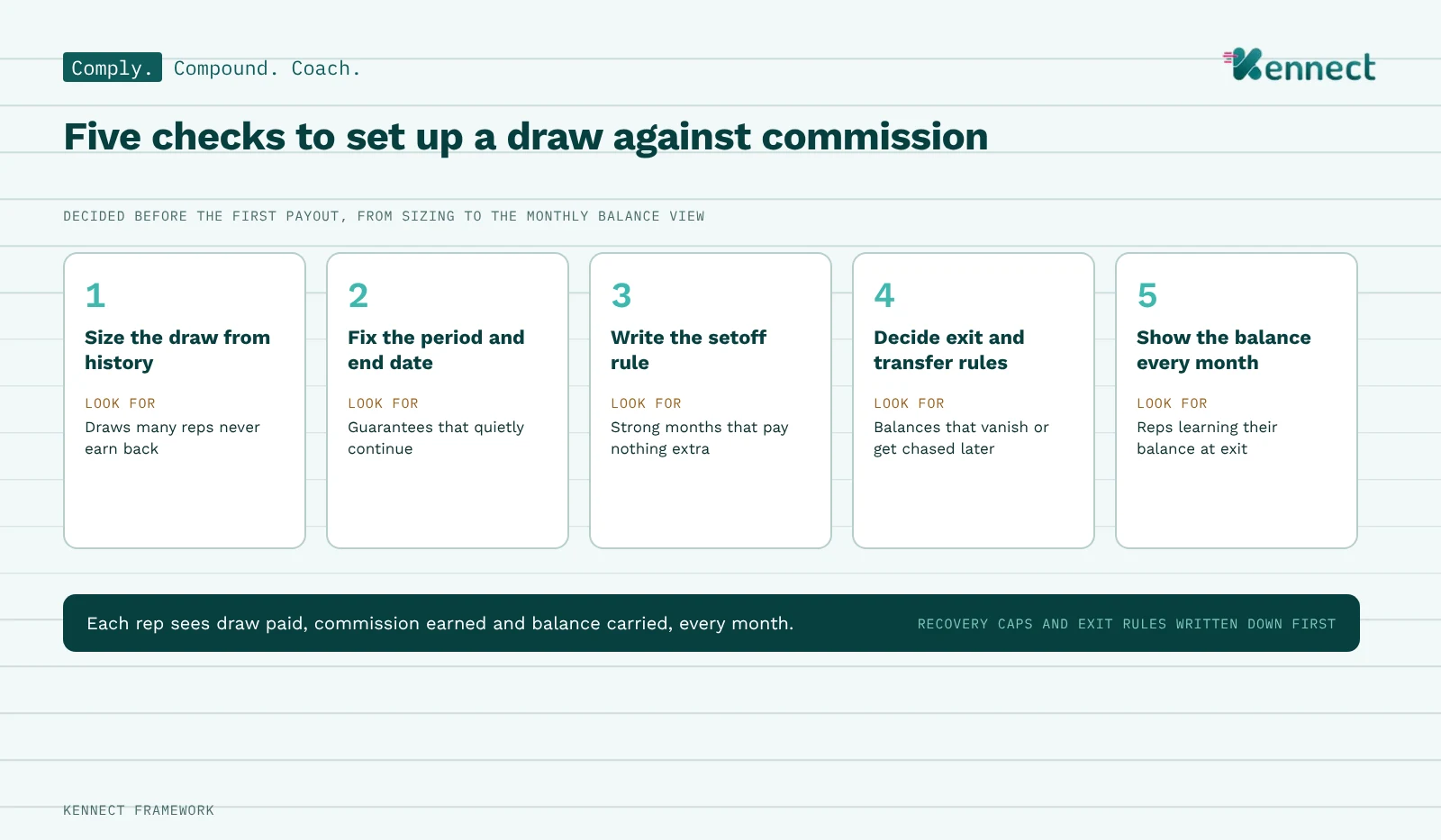
1. Size the draw from history. Look at what new reps in similar areas earned in their first months, and set the draw near that level. Look for: draws that many reps never earn back.
2. Fix the period and the end date. Say how many months the draw runs and what happens after. Look for: guarantees that quietly continue past the ramp.
3. Write the setoff rule. State whether shortfalls carry forward, and for how long. Cap how much of a good month goes to recovery. Look for: strong months that pay the rep nothing extra.
4. Decide the exit and transfer rules. Say what happens to a balance on resignation, transfer or promotion. Look for: balances that disappear, or get chased months later.
5. Show the balance every month. Each rep should see draw paid, commission earned and balance carried. Look for: reps learning their balance only at exit.
A draw reps can see is a draw reps can trust.
Recoverable, non-recoverable and guaranteed: which draw does what
Each type of draw puts the risk in a different place. Teams often need more than one.
Draw type
Who carries the risk
What it costs
Use it when
Recoverable draw
The rep, until the balance clears
Morale in strong months spent paying back
Earnings are lumpy but should even out within a quarter
Non-recoverable draw
The company
Write-offs when reps fall short
Ramp is predictable and keeping new hires matters
Guaranteed minimum for new joiners
The company, for a fixed period
A set cost per hire
Areas or relationships take months to build
Advance against a known sale
The company, until the sale completes
Recovery if the sale cancels
A disbursal, policy or order is approved but not yet credited
No draw, straight commission
The rep
Higher attrition in slow periods
Sales cycles are short and earnings are steady
Pick the draw by where the risk should sit, then write it down.
The guardrails that keep a draw fair
A draw needs controls on both sides. The company needs to recover fairly, and the rep needs to keep earning.
Cap recovery per month. Recover only part of any month's surplus, say half. The rep still gains from a strong month.
Set a carry-forward limit. Write off balances older than a set period, such as one quarter. Old debt rarely gets repaid.
Prorate on transfers and leave. A rep who moves mid-month gets a prorated draw for each role.
Link advances to the sale. For advances against a disbursal or policy, recover automatically if it cancels. Our guide to commission clawbacks covers the accounting.
Keep finance in the approval chain. Every draw, write-off and recovery gets an approver and a log.
Check recoveries against wage rules. Recovering from salary falls under the deduction limits. Take legal advice before recovering anything outside commission, and settle exit balances inside the two-day window.
Guardrails make recovery predictable, so it never feels personal.
A 30-day plan to put draws on clear rules
A new plan year isn't needed for this. One month is usually enough.
Week 1: Gather the balances. List everyone on a draw today, with type, amount, start date and balance. Find the rules each team actually follows.
Week 2: Write one policy. Agree the draw types, periods, setoff rule, recovery cap and exit rule with HR, finance and legal.
Week 3: Model and configure. Replay the policy on past months to see its cost. Set it up as rules in the incentive system.
Week 4: Brief and publish. Explain the rules to managers and reps. Show every rep their balance from the next payout.
Thirty days of clear rules saves years of case-by-case recovery.
How Kennect and KAI run draws
Kennect is an AI-led sales performance and incentive compensation management platform. One rule engine runs commission, draws and partner advances for every payee type.
Comply: draws as plan rules. Recoverable, non-recoverable and new-joiner guarantees run on the same rule engine as commission. Each month, the engine sets the draw off against earned commission and carries any balance forward.
Comply: a payout ledger. It tracks every draw, recovery and write-off by person. Recovery caps and carry-forward limits apply automatically. Every adjustment is logged for finance and compliance.
Comply: transfers and joiners. Mid-month moves prorate from the monthly hierarchy snapshot.
Compound: cost before launch.Scheme modeling shows what a draw policy would have cost on past data.
Coach: the rep's balance. Reps see draw paid, commission earned and balance carried on their phone.
One limit is worth stating. Software applies recovery rules. Whether they're fair or lawful is for HR and legal to settle first.
KAI in practice. A new rep asks why this month's payout was ₹20,000 despite a strong month. KAI Exceptions shows the draw balance cleared and what remains. A finance lead asks which reps carry balances older than a quarter. KAI Insights lists them by region, from the latest data load.
Kennect makes every draw balance visible, so recovery is never a surprise.
Running draws in a spreadsheet?
See a draw, its setoff and its balance run on one ledger.
An advance on commission a salesperson hasn't earned yet. The company pays a set amount each period, then sets it off against real commission. If earnings beat the draw, the rep gets the difference. If they fall short, the plan decides whether the gap is recovered or written off.
A recoverable draw is repaid from future commission. A non-recoverable draw isn't. With a recoverable draw, shortfalls carry forward as a balance. With a non-recoverable draw, the company absorbs the shortfall.
Only within the deduction rules, so take legal advice first. Under the Code on Wages, total deductions in a wage period can't exceed 50% of wages. Many companies recover draws from future commission instead.
Whatever the plan says, which is why it must say something. Some companies write off balances on exit. Others recover them from final settlement, within legal limits. Under the Code on Wages, final wages are due within two working days of a resignation.
Close to what similar new reps actually earned in their first months. A draw well above that creates balances many people never clear. Model it on past data before launch, and review it each quarter.